Skip to content

Botox vs. Dysport vs. Xeomin: Three Wrinkle Relaxers, One Right Choice for Holly Springs, NC
Botox, Dysport, and Xeomin are all FDA-approved injectables made from botulinum toxin type A, and they share the same core job: they temporarily quiet the muscles that crease your skin, softening frown lines, forehead lines, and crow’s feet. The real differences come down to how fast each one starts working, how it spreads through tissue, how its dosing units are counted, and what each one contains.
For most people, the best neuromodulator has less to do with the brand on the vial and more to do with the treatment area, your past results, and the judgment of the person choosing the product and dose.
Skynn MD keeps all three on hand, so the decision can be matched to you rather than to whatever a clinic happens to stock.
How neuromodulators work, and why they are not identical
All three products belong to the same active-ingredient family, botulinum toxin type A, and rely on the same mechanism. Injected in tiny, precise amounts into a target muscle, the toxin blocks the nerve signal (acetylcholine) that tells that muscle to contract. The muscle eases, and the dynamic lines it was folding into your skin, the 11s between the brows, horizontal forehead lines, and the fan of crow’s feet, relax and soften. The effect is temporary: nerve signaling returns gradually over the following months and the lines come back, which is why the treatment is repeated on a schedule.
This whole category goes by neuromodulators or wrinkle relaxers, and it is a different tool from dermal fillers: relaxers calm muscle movement, while fillers restore lost volume. Where the three relaxers diverge is in the fine print, the proteins that surround the toxin, the size of the molecule, the scale their units are measured on, and a few formulation details that occasionally matter for a specific patient.
Botox: the category benchmark
Botox (onabotulinumtoxinA) was the first neuromodulator approved for cosmetic use back in 2002, and it remains the reference point the others are measured against. It also carries the widest cosmetic footprint of the three: it is FDA-approved to treat frown lines, crow’s feet, forehead lines, and, as of 2024, the vertical platysma bands of the neck. That’s four aesthetic indications – more than any competitor. Results typically appear within a few days, build to a peak around 30 to 60 days, and last about three to four months.
Botox also has the longest therapeutic track record in the category, with established medical uses such as Botox for chronic migraine and excessive sweating. It contains human albumin along with the accessory proteins that naturally surround the toxin. For many patients and injectors, its predictability and broad approvals make it a sensible default, especially for a first treatment.
Dysport: fast onset and a wider spread
Dysport (abobotulinumtoxinA) is FDA-approved for frown lines and is known for two practical traits. It often kicks in quickly, with some people noticing a change within a couple of days, and it tends to diffuse a little more widely from each injection point. That broader spread can be an advantage across larger, flatter zones like the forehead, though it also asks for careful placement near more delicate areas such as around the eyes. Its effect lasts up to roughly four months.
Dysport’s units are counted on a different scale, roughly two and a half Dysport units for every one unit of Botox, so a higher number on your chart does not mean more product or a higher cost; the units simply are not interchangeable.
One safety point deserves emphasis: Dysport contains a trace of cow’s milk protein, so it is not used in anyone with a cow’s-milk-protein allergy. That is different from lactose intolerance, and it is a screening question a good provider will ask before treating.
Xeomin: the purified naked toxin
Xeomin (incobotulinumtoxinA) is purified to strip away the accessory proteins that surround the toxin in the other products, leaving only the active neurotoxin. That is why it is nicknamed the naked toxin. The theoretical benefit of carrying a lighter foreign-protein load is a lower chance of developing resistance over time, when the body forms neutralizing antibodies, which can matter to people who treat frequently or who feel their results have quietly faded over years.
Xeomin was first approved for frown lines, and its cosmetic approval has since expanded to include forehead lines and crow’s feet. Its median onset is around a week, and its effect lasts up to about three months. Conveniently, its dosing runs close to a one-to-one scale with Botox, which makes it a straightforward switch for patients moving from one to the other.
Botox vs. Dysport vs. Xeomin: how they compare
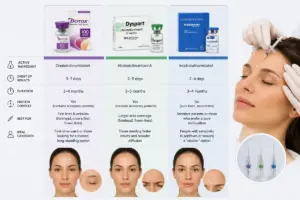
Side by side, the three share the same foundation and differ at the margins that a skilled injector uses to fine-tune a result:
| Product | Active ingredient | FDA cosmetic areas | Typical onset | Typical duration | Units vs. Botox |
|---|---|---|---|---|---|
| Botox | onabotulinumtoxinA | Frown lines, crow’s feet, forehead lines, platysma (neck) bands | Within days; peaks ~30-60 days | ~3-4 months | 1:1 (reference) |
| Dysport | abobotulinumtoxinA | Frown lines | Often fast (~2-3 days) | Up to ~4 months | ~2.5:1 |
| Xeomin | incobotulinumtoxinA | Frown lines, forehead lines, crow’s feet | Median ~1 week | Up to ~3 months | ~1:1 |
One caution when reading any comparison: because the unit scales are not interchangeable, comparing brands by unit count, or by price per unit, can mislead. Fifty units of Dysport is not five times more than ten units of Botox. The meaningful comparison is the total product needed for your muscles and the result it produces, which is exactly the call your provider is trained to make.
Which neuromodulator is right for you
The best choice usually falls out of a short list of factors. Treatment area comes first: for frown lines, all three are options; for on-label forehead lines and crow’s feet, Botox and Xeomin carry those specific approvals; and for neck (platysma) bands, Botox is currently the only on-label choice. Experienced injectors also use these products off-label when the evidence supports it.
Timing can tip the decision, since Dysport’s quicker onset is handy before an event, and so can your history, since long-time users who feel their results have dimmed sometimes do well switching to Xeomin. Medical screening matters too: a cow’s-milk-protein allergy rules out Dysport, and all three call for a review of your medications and conditions and are avoided in pregnancy and breastfeeding. Cost is calculated per unit, but because the unit scales differ between brands, a per-unit figure is not an apples-to-apples comparison; a provider estimates the total units your goals call for and gives you a personalized estimate at consultation. The through-line is simple: this is a clinical decision, best made with a provider who carries all three and can match product, dose, and area to your face.
What to expect: comfort, downtime, results, and safety
A neuromodulator appointment is quick. Treatment uses a very fine needle and most people describe only brief, minor pinches; numbing cream is available if you want it. Downtime is minimal, and you can generally return to your day, with the usual short-term advice to avoid rubbing the area, lying flat, or strenuous exercise for a few hours. Small bumps at the injection sites settle within an hour or so, and occasional light bruising is possible.
Results emerge over several days, at a pace that varies by product, and mature at around two weeks, then hold for roughly three to four months. On safety, all botulinum toxins share a class boxed warning about the toxin spreading beyond the injection site; that risk is tied to large therapeutic doses and is rare with cosmetic dosing and sound technique. Contraindications include a known hypersensitivity to the toxin, an active infection at the injection site, and, for Dysport specifically, a cow’s-milk-protein allergy. This is the part of the treatment where injector skill counts most, in choosing the right product, the right dose, and the right placement for a natural result.
Physician-led neuromodulator care in Holly Springs, NC
Choosing among Botox, Dysport, and Xeomin is a medical decision as much as an aesthetic one. It involves matching the product to the area, selecting a dose, screening your medications and health history, and reading how your muscles actually move, the kind of clinical judgment that keeps results looking natural and keeps care safe. That is why a physician-led practice fits this treatment so well.
At Skynn MD, care is led by founder and CEO Dr. Raghav Gotur, who is board-certified in Internal Medicine (ABIM, trained at Mount Sinai School of Medicine) and in Aesthetic Medicine (AAAM), with more than 20 years in medicine. That medical grounding is an advantage for a treatment whose products also carry therapeutic uses, from migraine to muscle conditions, that call for a clinician’s eye.
Skynn MD carries all three neuromodulators and can pair them with dermal fillers when a plan calls for both relaxing muscle movement and restoring volume. To weigh your options with a physician-led team, explore the full range of neuromodulator options at Skynn MD and book a consultation. The practice serves Holly Springs and the surrounding Triangle, including Apex, Cary, Fuquay-Varina, Morrisville, Garner, Raleigh, and the wider Wake County area. Ask about membership [add membership URL] if you plan to make maintenance a regular part of your routine.
Neuromodulator FAQs
Is Botox better than Dysport or Xeomin?
No single product is best for everyone. Each has strengths: Botox has the widest set of FDA-approved treatment areas, Dysport often acts fast and spreads well across broader zones, and Xeomin is a purified formula that some long-term users prefer. The right choice depends on the treatment area, how quickly you want results, your history with these injectables, any allergies, and your injector’s judgment.
Which neuromodulator works the fastest?
Dysport often shows the earliest movement, sometimes within a couple of days. Xeomin typically begins around a week, and Botox starts within a few days and peaks around a month. For all three, results usually mature by about two weeks.
How long do the results last?
Botox and Dysport generally last about three to four months, and Xeomin lasts up to about three months. Duration varies with the person, the area treated, the dose, and how active those muscles are. Regular maintenance keeps results consistent.
Can I switch between Botox, Dysport, and Xeomin?
Yes, many people move between them without trouble. Because the dosing units are counted on different scales, your provider recalculates the dose for each product rather than matching unit for unit. Some people switch to Xeomin if they feel their results have faded over years of treatment.
Why do the unit numbers differ so much between products?
Each brand measures its units on its own scale, so the numbers are not interchangeable. Dysport uses roughly two and a half units for every one unit of Botox, which means a larger unit count is not more product or a higher price. What matters is the total effect your provider is aiming for.
Is one of them safer than the others?
All three belong to the same class and share the same boxed warning about the toxin spreading beyond the injection site, which is rare at cosmetic doses given by a trained injector. The main product-specific caution is that Dysport contains a trace of cow’s milk protein and is not used in people with a cow’s-milk-protein allergy. A thorough screening for medications and medical conditions applies to all three.
Do these treat anything besides wrinkles?
Yes. Botulinum toxin type A is also used for medical concerns such as chronic migraine, excessive sweating, and certain muscle conditions, physician-gated uses that go well beyond cosmetics. These therapeutic applications are one reason a medically-led practice is well suited to the treatment.
How do I know which one is right for me?
The most reliable way is a consultation with a qualified provider, ideally a physician-led practice that carries all three, who can match the product, dose, and treatment area to your goals. Screening for allergies, medications, and medical history is part of that visit.