Skip to content



Sagging neck skin can make the jawline look softer, and the lower face appear older than you feel, but the right treatment can help improve firmness, smoothness, and definition without guessing your way through options. From RF microneedling and laser skin tightening to PDO threads or surgical correction for more advanced laxity, a personalized plan can target the real cause of your saggy neck and help you choose the most effective next step for your goals.
Which is better for a saggy neck: a surgical or a non-surgical procedure?
Surgical treatment may be better for a saggy neck with significant loose skin or neck bands, while non-surgical treatment may be better for mild to moderate sagging with less downtime.
What Causes Saggy Neck Skin?
The neck is one of the first areas to show visible aging because the skin is naturally thinner and often receives less daily sun protection than the face. Over time, collagen and elastin decrease. These are the support proteins that help skin stay firm and flexible.
As this support weakens, the skin may begin to look loose or finely wrinkled. The jawline can also become less sharp as soft tissue shifts. In some cases, the platysma muscle in the neck becomes more visible, creating vertical bands. Fat under the chin can add fullness, which may make skin laxity look more noticeable.
Because several factors can contribute to neck aging, the best plan is not always one single treatment. Some patients may need skin tightening. Others may need lifting, resurfacing, fat reduction, or surgery for a more complete change.
Non-Surgical Options for Saggy Neck Skin
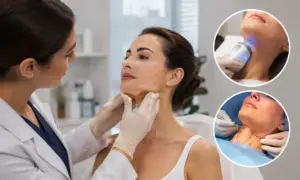
Non-surgical options are often best for mild to moderate sagging, early skin laxity, and texture changes. These treatments usually aim to stimulate collagen, tighten the skin gradually, or give the lower face and neck a more supported look without resorting to incisions.
A non-surgical saggy neck treatment can be a practical choice for someone who wants improvement with less downtime. Results are usually more subtle than surgery, and some treatments require a series of sessions. Still, for the right candidate, non-surgical care can make the neck appear smoother, firmer, and more refreshed without the recovery involved in a surgical neck lift.
RF Microneedling for Neck Tightening
RF microneedling combines tiny controlled punctures with radiofrequency heat energy. The microneedles create small channels in the skin while radiofrequency energy warms the deeper layers. This process encourages the body to produce new collagen and elastin.
For neck concerns, RF microneedling can be useful when the skin looks crepey, mildly loose, or uneven in texture. It can help firm the appearance of the neck over time, especially when the skin still has enough elasticity to respond.
This procedure is minimally invasive, and downtime is typically limited compared with surgery. Redness, swelling, and tenderness may occur following the microneedling treatment. However, these effects should be temporary. Outcomes develop gradually as collagen remodeling takes place. Some patients may need multiple sessions, depending on the degree of laxity and the provider’s recommendation.
RF microneedling is not meant to remove excess skin. If the neck has heavy folds or significant hanging skin, the improvement may be limited. It works best when the goal is firmer texture and mild tightening rather than major lifting.
Laser Skin Tightening
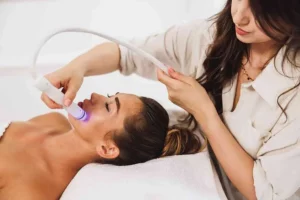
Laser skin tightening is a non-invasive treatment that uses laser energy to heat deeper layers of the skin. This controlled heat helps stimulate collagen production, which can lead to tighter and smoother-looking skin over time.
This option may be recommended for patients with mild laxity, fine lines, or skin texture changes around the neck. It can be especially helpful when the concern is not only looseness, but also roughness or visible aging on the skin’s surface.
Laser treatment plans vary depending on the device used, the patient’s skin type, and the depth of concern being addressed. Some treatments focus more on tightening, while others may also improve tone and texture. Recovery can range from little downtime to several days of redness or sensitivity, depending on how aggressive the treatment is.
Laser skin tightening is not a substitute for surgery when excess skin is advanced. It can improve skin quality, but it cannot physically remove loose skin or reposition deeper tissues.
PDO Thread Lift for Neck and Jawline Definition
A PDO thread lift is another minimally invasive treatment that uses biodegradable threads placed beneath the skin to provide a subtle lifting effect. The threads help support lax tissue and can also encourage collagen production as they dissolve over time.
For the neck, PDO threads may help improve mild to moderate laxity and create a more defined transition between the jawline and neck. This can be a good option for patients who want a lifted appearance without undergoing surgery.
The results are typically more noticeable than collagen-stimulation treatments alone, but they are still not the same as a surgical lift. PDO threads can reposition mild laxity, but they cannot remove large amounts of excess skin. Some swelling, tenderness, bruising, or tightness can occur after the procedure.
A careful consultation matters with PDO threads because placement, skin quality, and the amount of laxity all affect the outcome. This option works best when the skin is not too heavy, and the treatment goal is subtle lifting and contour support.
Surgical Options for Saggy Neck Skin
Surgical treatment may be a better fit when the sagging neck becomes more advanced. A neck lift can address excess skin, deeper tissue laxity, and visible neck bands in a way that non-surgical treatments cannot.
During a neck lift, a surgeon may remove loose skin, tighten underlying muscles, adjust fat, and improve the contour of the neck and jawline. The exact approach depends on the patient’s anatomy and goals.
Surgery usually creates a more noticeable and longer-lasting result than non-surgical treatment, but it also involves more recovery. Bruising, swelling, tightness, and activity limits are expected during the healing period. Patients also need to consider anesthesia, surgical risks, and time away from normal routines.
For someone with significant skin folds or a pronounced “turkey neck” appearance, surgery may provide a more direct correction. For someone with only early laxity, surgery may be more than what is needed.
Non-Surgical vs Surgical: How to Decide
The best choice still depends on the severity of the sagging and what the patient aims to improve.
Non-surgical treatments are generally better for early laxity, mild crepey skin, fine lines, and patients who prefer less downtime. RF microneedling, laser skin tightening, and PDO threads can each play a role. However, it is important to emphasize that they work in different ways.
- RF microneedling supports collagen and texture.
- Laser skin tightening helps firm and smooth the skin.
- PDO threads can provide a subtle lift for selected patients.
Surgical treatment is usually more appropriate when loose skin is heavy, neck bands are prominent, or the jawline has lost significant definition because of deeper tissue changes. A neck lift can address structure in a way that energy-based treatments and threads cannot.
Neither option is automatically better. The better choice is the one that matches the skin, anatomy, recovery preference, and expected result.
SKYNN MD Saggy Neck Treatment in Holly Springs, NC
SKYNN MD offers non-surgical neck lift options for patients looking to improve sagging neck skin without immediately moving toward surgery. Our team understands that neck laxity can affect how people feel about their appearance, especially when the lower face no longer reflects how they feel overall.
At SKYNN MD, treatment options may include RF microneedling, laser skin tightening, PDO thread lift procedures, or a combination approach, depending on the patient’s concerns. The goal is to assess the neck carefully, discuss realistic expectations, and recommend a plan that fits the degree of sagging, skin quality, and comfort level with downtime.
For patients considering saggy neck treatment in Holly Springs, NC, a consultation can help determine which non-surgical option may be most appropriate. Some patients may benefit from collagen-focused treatments, while others may need lifting support or a referral for surgical evaluation if laxity is more advanced.
Frequently Asked Questions
What is the best treatment for a saggy neck?
The best treatment depends on the amount of loose skin, with non-surgical options helping mild to moderate sagging and surgery often being better for more advanced laxity.
When is surgery better than non-surgical saggy neck treatment?
Surgery may be a better option when the neck has significant loose skin, heavier folds, or prominent muscle banding that non-surgical treatments cannot fully correct.
When will I see results?
You may start seeing gradual improvement within a few weeks, but results from non-surgical saggy neck treatments usually continue to develop over several months as collagen production increases.