Skip to content



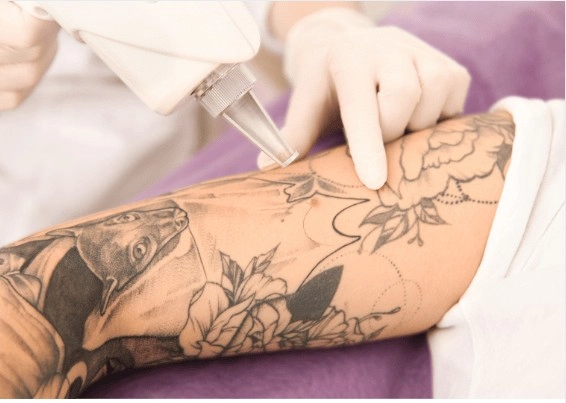
If you’re considering tattoo removal, you’ve probably noticed how far laser technology has come over the past decade. At Skynn MD Medspa, we’re proud to offer PicoLazer Tattoo Removal, one of the most advanced and effective laser treatments available today. In this guide, we break down how tattoo removal works, compare traditional and picosecond lasers, and explain what makes PicoLazer a top choice for clearer skin.
How does Laser Tattoo Removal Work?
Laser tattoo removal works by delivering rapid pulses of energy that target and shatter ink particles beneath the skin into smaller pieces.

These smaller ink particles are then removed over time by the body’s immune system, fading the tattoo session by session.
With each patient taking about 4-8 sessions to completely fade the tattoo, depending on size, color, and complexity. ASLMS
See our blogpost How does Laser Tattoo Removal Work? for a more in-depth view.
Types of Laser Tattoo Removal Machines
There are multiple types of laser tattoo removal machines, with the main types being, Q-Switched and Picosecond. With the main difference being pulse speed or how fast and each type having their own pros and cons.
Q-Switched Laser (The Fast One)
These types of laser are more common and established. Q-switched lasers deliver energy in nanosecond pulses; billionths of a second (really fast).
These short, rapid pulses break the pigments of the tattoo into tiny particles which lets the body’s immune system remove them. However, its larger pulses exposes the skin for longer periods of time leading to more heating of the skin which can lead to unwanted side effects.
Pros:
- Effective at removing darker pigments like black and deep blue.
- Well-established technology used for decades.
Cons:
- Often requires more treatment sessions.
- Less effective on stubborn colors like green, yellow, and red.
Picosecond Laser/Pico-Laser (The Really Fast One)
Emits ultra-short, high-energy pulses to the target (tattoo/pigmented spots) measured in picoseconds which is trillionths of a second (really really fast) making it more efficient in breaking down the pigments/ink of the tattoo.
This results in faster and fewer sessions and reduced risk of side effects.
Pros:
- Fewer sessions required
- Treats multiple ink colors effectively
- Reduced thermal damage to skin
Cons:
- Advanced technology can mean higher cost per session
Picosecond vs. Q‑Switched Laser: A Side‑by‑Side Comparison
| Features | Picosecond Laser | Q‑Switched Laser |
| Pulse Duration | Picoseconds (10⁻¹² sec) | Nanoseconds (10⁻⁹ sec) |
| Sessions Needed | Fewer Sessions (commonly 4–8) needed. | More Sessions (often 8–12 or more) |
| Color Coverage | Better for Multi‑color Tattoos | Good for dark inks |
| Ink Breakdown | Ultra-fine dust | Larger chunks |
| Speed of Ink Fragmentation | Faster & more effective | Moderate |
| Thermal Impact / Risk of Side Effects | Lower (less heat) | Higher |
| Comfort & Recovery | More Comfortable & Less Downtime. | Less comfortable & Slower Recovery. |
| Cost / Availability | Usually more expensive (equipment cost + per‑session fee) because of newer technology. | More affordable and widely available — a more traditional and established option. |
Clinical reviews show picosecond lasers offer superior clearance of certain colors, including blue and green inks, compared to nanosecond systems, while both are safe and effective for black tattoos. PubMed
What This Means for You:
With the PicoLazer at Skynn MD Medspa, you benefit from a cutting‑edge solution that often means:

- Fewer appointments to achieve your goals
- Broad color removal capability
- Reduced risk of skin damage and downtime
- Treatments tailored to your skin and tattoo characteristics
It’s important to understand that tattoo removal is a gradual process and results vary. The number of sessions depends on factors such as the tattoo’s age, color complexity, depth, and your skin type. Consulting with a qualified provider ensures the best customized plan for you.

How Picosecond Tattoo Removal Works
Here is the simplified process:
- Laser Targets Pigment
The laser’s wavelength is absorbed only by tattoo ink—not the surrounding skin. - Ultrafast Pulses Create Shockwaves
In trillionths of a second, the laser delivers a photoacoustic impact that fractures the ink. - Ink Shatters into Dust-Like Particles
Much smaller than the fragments created by Q-Switched lasers. - Body Naturally Removes the Ink
Macrophages (immune cells) carry the ink particles through the lymphatic system. - Tattoo Fades Over Time
Each session clears more pigment; full removal requires multiple sessions.
How Many Sessions Will I Need?
Most people need 6–12 sessions, depending on:
- Tattoo age
- Colors used
- Depth and density of ink
- Location on the body
- Skin type
- Immune response
Older or amateur tattoos often fade faster than new, professional ones.

What to Expect During Your Appointment
Before Treatment
- Skin is cleansed
- Protective eyewear is placed
- Numbing cream may be applied if needed
During Treatment
- You’ll feel quick, warm snaps (similar to a rubber band)
- Sessions typically take 5–15 minutes
- White “frosting” on the skin is normal
After Treatment
- Mild redness or swelling for a few hours
- Avoid direct sun exposure
- Keep the area clean and moisturized
- Healing typically takes 7–10 days
Results improve every 4–6 weeks as your body clears more ink.
Common PicoLazer/Picosecond Laser Myths
❌ MYTH #1: Picosecond lasers permanently damage the skin
✅ FACT: Picosecond lasers use ultra‑short pulses that focus on ink or pigment while minimizing heat to surrounding skin. When performed by trained providers, treatments are considered safe and well‑tolerated.
(PubMed: https://pubmed.ncbi.nlm.nih.gov/32763326/>).
❌ MYTH #2: Tattoos disappear in one session
✅ FACT: Tattoo removal is a gradual process. Picosecond lasers often reduce the number of sessions needed, but most patients still require multiple treatments based on tattoo size, color, and depth.
(AAD: https://www.aad.org/public/cosmetic/hair-removal/laser-tattoo-removal).
❌ MYTH #3: All laser tattoo removal works the same
✅ FACT: Picosecond lasers work differently than older lasers. Their faster pulses break ink into much smaller particles, helping the body clear pigment more efficiently — especially stubborn colors.
(PubMed: https://pubmed.ncbi.nlm.nih.gov/32763326/).
❌ MYTH #4: Picosecond lasers are only for tattoo removal
✅ FACT: Picosecond lasers are also used to treat sun spots, pigmentation issues, acne scars, fine lines, and improve overall skin texture.
(PubMed: https://pubmed.ncbi.nlm.nih.gov/32282094/).
❌ MYTH #5: The laser removes the tattoo all by itself
✅ FACT: The laser breaks ink into tiny fragments, but your body’s immune system does the work of clearing those particles over time — which is why sessions are spaced weeks apart.
(PubMed: https://pubmed.ncbi.nlm.nih.gov/32763326/; AAD: https://www.aad.org/public/cosmetic/hair-removal/laser-tattoo-removal).
Why Laser Tattoo Removal Is the Standard Today
Dermatologists agree that laser tattoo removal significantly outperforms other techniques, such as creams or surgical approaches, for safety, effectiveness, and predictability. Lasers continue to evolve and are the most trusted method available when performed by experienced professionals. American Academy of Dermatology
And with the availability of both Picosecond and Q-Switched lasers at Skynn MD, you are assured that your treatments are tailored to your needs. For simple black ink tattoos on a budget, get treated with our Q-Switched laser.
For more complex, multi-colored tattoos, get treated with PicoLazer and experience faster sessions, faster recovery time, and faster fading. With its precision, efficiency, and versatility, PicoLazer tattoo removal has become a leading choice for patients seeking effective, safe, and modern tattoo fading solutions.
Say Goodbye to Unwanted Tattoos!
Experience safe, effective, and faster tattoo removal with PicoLazer at Skynn MD Medspa. Our expert team will guide you through a personalized treatment plan to achieve the best results for your skin type and tattoo.
Whether you’re addressing your first tattoo or a complex multi‑colored design, Skynn MD Medspa combines advanced laser science with expert medical care to help you achieve your skin goals.
Book your free consultation today and take the first step toward smooth, tattoo-free skin!
FAQs
Who is a good candidate for PicoLazer tattoo removal?
Good candidates are generally healthy adults with unwanted tattoos. PicoLazer works on most ink colors and skin types, but a consultation is necessary to assess tattoo size, color, and placement. (AAD, 2025).
Does PicoLazer tattoo removal permanently remove tattoos?
Laser treatment can significantly fade or completely remove tattoos. Results vary depending on ink type, depth, age of the tattoo, and your body’s response. Multiple sessions are typically required for optimal results. (AAD, 2025).
Is there any downtime or side effects with PicoLazer tattoo removal?
Most patients experience mild redness, swelling, or temporary blistering immediately after treatment. These effects typically resolve within a few days. Proper aftercare helps minimize side effects and promotes healing. (Goldberg et al., 2018).
How many sessions will I need?
The number of sessions depends on factors like tattoo color, size, depth, and location. On average, PicoLazer treatments require fewer sessions than traditional Q-Switched lasers, making it faster and more efficient for multi-colored tattoos. (Leal et al., 2020).
Can PicoLazer treat all tattoo colors effectively?
Yes, picosecond lasers are particularly effective at removing difficult colors such as blue and green due to their ultra-short pulses that break ink into smaller particles for easier clearance. Studies show picosecond lasers outperform Q-Switched lasers on multi-colored tattoos (Leal et al., 2020).