Skip to content



By Dr. Raghav Gotur — board-certified in Internal Medicine (ABIM) and Aesthetic Medicine (AAAM), founder of Skynn MD. Medically reviewed for accuracy by Dr. Gotur.
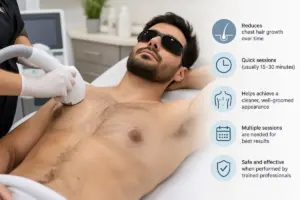
More men are booking laser hair removal for the chest than ever, whether the goal is a cleaner look under a shirt, less shaving irritation, or an end to the ingrown-hair cycle. The honest version of what to expect is straightforward: chest laser hair removal uses light to disable hair follicles over a series of sessions, most men need several visits, and the result is long-term hair reduction rather than a single, permanent fix. Below is a full walk-through of how it works, how many sessions it takes, how much it hurts, what it costs, and how to get the best result.
Key takeaways
- Laser targets the pigment in each hair, so it works best on dark chest hair; most men get lasting reduction over a series, not from one visit.
- Plan on 6 to 10 chest sessions, spaced 4 to 6 weeks apart.
- Expect roughly a 3 to 4 out of 10 for discomfort — a quick snap plus cooling; the chest is one of the more tolerable areas.
- It is permanent hair reduction, not permanent removal — think 70 to 90 percent long term, with occasional touch-ups.
- Men often treat the chest with the stomach, shoulders, or back for a natural edge; the nipple and areola area can be treated with care.
- Cost depends on area size, hair density, and session count; a consultation gives an exact quote.
How does laser hair removal work on the chest?
Laser hair removal sends a pulse of light into the skin, where the pigment inside each hair absorbs it and converts it to heat, which damages the follicle and slows or stops future growth. On the chest, dark and coarse hair responds especially well because it holds plenty of the pigment the laser is built to find.
Hair grows in cycles, and the laser can only disable a follicle that is in its active growth phase at the moment of treatment. At any given time only a share of your chest hair is in that phase, which is why the treatment is done as a series rather than all at once. If you want the underlying science in more detail, our overview of how laser hair removal works breaks down the growth cycle and why timing matters. The chest uses the same mechanism as any other area, and it happens to be one of the more cooperative zones on the male body — the target is laser hair removal on the chest where dense, dark hair gives the laser a clear signal to lock onto.
How many sessions will you need for chest hair?
Most men need about 6 to 10 chest sessions spaced 4 to 6 weeks apart. The range exists because hair grows in cycles, so each session catches a new set of follicles in active growth, and it takes several passes to work through them all.
Most men need 6 to 10 chest sessions spaced 4 to 6 weeks apart, because the laser only disables follicles that are actively growing at each visit.
Denser, coarser chests tend toward the higher end of the range, while a thinner, patchier chest may finish sooner. After the initial series, many men come back once or twice a year for a maintenance session to catch the occasional follicle that reactivates. Here is how the chest compares with the other areas men most often bundle with it:
| Area | Typical sessions | Comfort (1–10) | Notes |
|---|---|---|---|
| Chest | 6–10 | ~3–4 | Dark, dense hair responds well; a favorable area to treat |
| Chest + stomach | 6–10 | ~3–4 | Treated together to avoid an obvious line at the waist |
| Shoulders / upper back | 8–12 | ~4–5 | Larger surface and coarse hair push the session count up |
| Nipple / areola | Within chest series | Higher | More sensitive; treated with extra care when appropriate |
Does chest laser hair removal hurt?
Most men rate chest laser hair removal around a 3 to 4 out of 10 — a quick snap like a rubber band, followed right away by a cooling sensation. The chest is one of the more tolerable areas because the skin sits over muscle rather than close to bone.
Most men rate the chest around 3 to 4 out of 10 — a quick snap followed by cooling — making it one of the more tolerable areas to treat.
Sensation varies with hair density, the energy settings, and your own tolerance, and the skin near the sternum and nipples can feel more sensitive than the outer chest. Most men get through a session without numbing cream, though it is available if you want it, and the built-in cooling on modern devices takes the edge off each pulse. Compared with waxing a large area, which many men rank a 7 or 8 out of 10, laser is the far more comfortable option for the amount of hair it removes over time.
Is chest laser hair removal permanent, and what results can you expect?
Laser hair removal is FDA-cleared for permanent hair reduction, not permanent removal. In practice, most men keep roughly 70 to 90 percent of treated chest hair gone over the long term, with occasional maintenance sessions to catch follicles that reactivate.
Chest laser hair removal is FDA-cleared for permanent hair reduction, not removal — most men keep about 70 to 90 percent of treated hair gone long term, with occasional touch-ups.
That distinction matters. Reduction means the treated hair grows back finer, sparser, and slower, and much of it stops coming back at all; removal, in the strict sense, describes electrolysis, which works follicle by follicle. Some men aim for a fully smooth chest, while others prefer to thin dense hair so the chest still looks natural but far less heavy — both are reasonable goals. Results vary from person to person, and because hormones can activate new follicles over the years, a periodic touch-up keeps things looking consistent. A consultation is where a realistic result for your hair and skin gets mapped out.
Treating the chest with the stomach, shoulders, or back
Chest hair rarely stops at a clean line, so many men treat the chest together with the stomach, shoulders, or upper back to avoid an obvious edge. The nipple and areola area can be treated too, with extra care, since it is more sensitive than the rest of the chest.
The most common pairing is chest and stomach, which keeps the midline (including the so-called happy trail) consistent from the collarbone down. Men whose chest hair creeps onto the shoulders often add that zone so the treated area blends rather than ends abruptly, and plenty of men bundle the back at the same time. If you are planning to address several zones, treating them under one plan is usually more efficient than booking each separately — our full-body laser hair removal option is built for exactly that, and you can see the full menu of areas on our laser hair removal page. Chest work is also one of the most requested services within men’s laser hair removal overall.
Laser vs. shaving and waxing for chest hair
Shaving and waxing remove the hair you already have; laser is the only one of the three that reduces how much grows back over time. Shaving brings stubble and razor bumps within days, waxing means recurring pain and ingrown hairs, while laser front-loads the effort into a session series and then largely steps back.
| Method | How long you stay smooth | Discomfort | Long-term regrowth |
|---|---|---|---|
| Laser | Lasting reduction over a series | ~3–4/10, brief per pulse | Large, long-term reduction |
| Shaving | 1–3 days | None during; irritation after | None — full regrowth |
| Waxing | 3–6 weeks | ~7–8/10 | None — full regrowth |
For a man who is tired of daily stubble, razor bumps, or the wax-and-regrow treadmill, that last column is the whole point: laser is the option that gets less demanding over time instead of more. It also tends to reduce ingrown hairs, since there is progressively less hair left to curl back into the skin.
What does chest laser hair removal cost?
The cost of chest laser hair removal depends on the size of the area, how dense the hair is, and how many sessions your plan calls for. Most clinics price a package of sessions lower than the same number bought individually, and a consultation is where you get an exact figure for your chest.
Because a thick, full chest needs more sessions than a light, patchy one, any price quoted sight-unseen is a guess. Treating the chest together with the stomach or shoulders changes the total as well. The most useful way to think about it is value over time: laser is an upfront series that replaces years of razors, wax appointments, and the products that go with them. For men who plan to maintain results or treat more than one area, a membership can make ongoing care more economical, and our team will lay out the options at your visit.
How to prepare for a session and what to do afterward
Prep is simple: shave the chest 12 to 24 hours before your session, and avoid sun exposure, tanning, waxing, and plucking in the weeks beforehand. Afterward, treat the skin gently — cool it, moisturize, protect it from the sun, and skip the sauna or a hard sweat for a day or two.
Before your appointment
- Shave the area 12 to 24 hours ahead so the laser targets the follicle, not surface hair.
- Avoid sun and tanning beds for about two weeks; a fresh tan raises the risk of irritation, so reschedule if you have one.
- Do not wax, pluck, or epilate beforehand — the laser needs the root in place to work.
- On the day, come with clean skin and skip lotions, deodorant, and cologne on the chest.
After your appointment
- Expect mild redness or a warm, sunburn-like feeling for a few hours; a cool compress and fragrance-free moisturizer help.
- Protect the area from the sun and use sunscreen once any redness settles — sun-exposed skin is more reactive, and the chest catches a lot of it (see how sun exposure affects skin on the neck and chest).
- Skip the gym, sauna, and hot showers for a day or two to avoid irritating freshly treated skin.
- Do not pick or scratch; let any shed hairs work their way out over the following days.
Is chest laser hair removal safe for your skin tone and hair color?
Modern lasers can treat a wide range of skin tones safely when the device and settings are matched to you, which is exactly why the assessment matters. The real limitation is hair color, not skin color: dark hair responds best, while gray, blonde, and red hair have little pigment for the laser to target.
The treatment works on the contrast between hair and skin, so the classic ideal is dark hair on lighter skin. Darker skin tones can be treated safely, but they call for the right wavelength and conservative settings in experienced hands, because the wrong settings raise the risk of burns or pigment changes. That is where trained judgment earns its keep — reading your skin type, choosing the device and energy, and adjusting across the chest. Men with very light, gray, or red chest hair are the group most likely to see limited results, and an honest provider will tell you that up front rather than sell you a series that cannot deliver.
Physician-led chest laser hair removal at Skynn MD
Laser hair removal is a light-based medical treatment, so who is behind the device matters as much as the device itself. Matching the laser to your skin tone, setting the energy, screening your skin and medications, and treating sensitive spots like the nipple area safely are all clinical judgments, not cosmetic guesswork.
Skynn MD is a physician-led practice in Holly Springs, NC, founded by Dr. Raghav Gotur, who is board-certified in Internal Medicine (ABIM, trained at Mount Sinai School of Medicine) and in Aesthetic Medicine (AAAM), with more than 20 years in medicine. That medical grounding is a real advantage for a treatment where skin-tone matching and safety screening decide both the result and the risk. [If a named lead laser technician performs these treatments, feature them here alongside Dr. Gotur — add name, license, and experience.]
If you are weighing chest laser hair removal, a consultation is the honest next step: your hair and skin get assessed, your candidacy is confirmed, and a realistic plan and quote are mapped to you. You can start with our laser hair removal on the chest service page, explore the broader men’s laser hair removal options, or reach the team through our Holly Springs med spa to book. There is no pressure to commit to a full series before you know it is right for you.
Frequently asked questions
How many sessions does chest laser hair removal take for men?
Most men need about 6 to 10 sessions on the chest, spaced 4 to 6 weeks apart, and coarser, denser hair tends toward the higher end of that range. Because hair grows in cycles, several passes are needed to catch each follicle during active growth. Occasional maintenance sessions may follow, and individual results vary.
Does chest laser hair removal hurt?
Most men describe it as a 3 to 4 out of 10 — a quick snapping sensation followed by cooling. The chest is generally more comfortable than the face or neck, though the area near the sternum and nipples can feel more sensitive. Cooling devices and optional numbing cream make it easier.
Is chest laser hair removal permanent?
Laser hair removal is FDA-cleared for permanent hair reduction, not permanent removal. Most men see roughly 70 to 90 percent long-term reduction on the chest, though some follicles can reactivate over time. Occasional maintenance sessions keep results looking consistent, and results vary from person to person.
How much does chest laser hair removal cost?
Cost depends on the size of the area, how dense the hair is, and how many sessions your plan needs. A package of sessions usually costs less than buying them one at a time. The most reliable way to get an accurate figure is a consultation, where the chest is assessed and a plan is mapped out.
Can the nipple and areola area and the stomach be treated too?
Yes. Many men treat the chest along with the stomach, shoulders, or upper back so there is no hard line where treatment stops. The nipple and areola area can be treated with extra care because it is more sensitive, and your provider will confirm what is appropriate for you.
Does laser hair removal work on dark skin or on light or gray hair?
Modern lasers can treat a wide range of skin tones safely when the device and settings are matched correctly, which is why an experienced, physician-led assessment matters. The bigger limitation is hair color: dark hair responds best, while gray, blonde, and red hair have too little pigment for the laser to target well.
How should I prepare for a chest laser session?
Shave the chest 12 to 24 hours before your appointment so the laser targets the follicle rather than surface hair. Avoid sun exposure and tanning for about two weeks beforehand, and do not wax or pluck, since the laser needs the root in place. On the day, skip lotions, deodorant, and cologne on the area.
Is chest laser hair removal worth it compared with shaving or waxing?
For many men, yes — laser is the only one of the three that reduces regrowth over time, so upkeep drops sharply once the series is done. Shaving brings daily stubble and razor bumps, and waxing means recurring pain and ingrown hairs. Whether it is right for you comes down to your hair, skin, and goals, which a consultation can confirm.