Skip to content




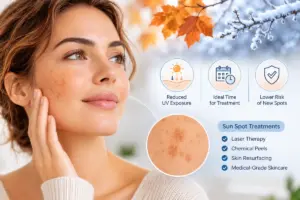
The best time of year to treat sun spots is fall and winter. During the cooler months, ultraviolet light is weaker and you spend less time outdoors, which means treated skin heals with less interference and your results are easier to protect. Treatments like IPL photofacials and chemical peels also work best on skin that is not freshly tanned, so the weeks after summer are a natural window to start. If those brown spots showed up after a season in the sun, now is a good time to start.
The short version
- Fall and winter are the best seasons to treat sun spots because lower UV makes healing easier and results easier to protect.
- Most treatments work best on untanned skin, so post-summer is the natural starting point.
- Common in-office options include IPL photofacials, chemical peels, and other laser and light treatments, usually over a short series.
- Wear broad-spectrum sunscreen every day, year-round. Without it, new spots can form and treated ones can return.
- See a provider first. What looks like a harmless sun spot can occasionally be something that needs medical attention.
What is the best time of year to treat sun spots?
Fall and winter are the best time of year to treat sun spots. UV exposure is the main cause of sun spots, and it is also the biggest obstacle to healing well after a pigment treatment.
The best time of year to treat sun spots is fall and winter, when lower UV exposure allows treated skin to heal with less risk of new pigment forming and makes results easier to maintain.
In the cooler months, the sun is lower and days are shorter, so the UV reaching your skin is naturally weaker. You are also covered up more and spending more time indoors. All of that protects skin that is recovering from a treatment, which is exactly when it is most vulnerable to forming fresh pigment. Starting in fall also means you can complete a series through the winter and, for many people, see clearer skin by the time spring arrives.
Why does treating pigment in cooler months work better?
Treating pigment in cooler months works better because sun exposure both causes sun spots and sabotages their treatment. Sun spots form when UV light prompts the skin to produce excess melanin, the pigment that gives skin its color. Treatments like IPL and peels work by targeting that pigment so the spots break up and fade. If fresh UV hits the skin during recovery, it can trigger new melanin and undo the progress, sometimes leaving skin looking blotchier than before.
Many pigment treatments also perform best on skin that has not been recently tanned, because a tan adds background pigment that competes with the target. That is why late fall through winter, once any summer color has faded, tends to be the smoothest window for both the treatment itself and the healing that follows.
What are sun spots, and why did mine show up after summer?
Sun spots, also called solar lentigines, are flat brown or tan patches that appear on skin exposed to the sun over time. They most often show up on the face, hands, chest, and shoulders, the areas that catch the most sunlight. They reflect years of cumulative sun exposure, not just this past summer.
They tend to become noticeable at the end of summer because months of sun have stimulated extra melanin, and that pigment settles into visible spots. In a place like Holly Springs, where the warm season runs long and summers are bright and humid, it is common to notice new or darker spots once the season winds down. If you are seeing them now, you are seeing the result of this year’s sun on top of the years before it.
Not every brown patch is a sun spot. Melasma, for example, is a related pigment condition driven by hormones as well as sun, and it is treated differently. That is one more reason to have any discoloration assessed instead of guessing at the cause.
How are sun spots treated?
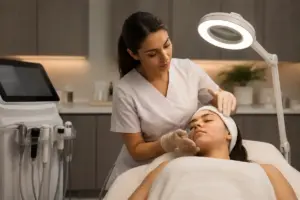
Sun spot treatment uses in-office procedures that target and break up excess pigment, most commonly IPL photofacials, chemical peels, and other laser or light treatments. Most people need a short series of sessions rather than a single visit, and the right option depends on your skin and the depth of the pigment.
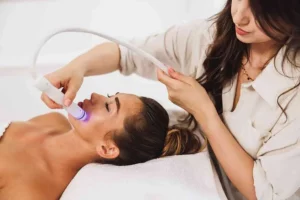
An IPL photofacial uses broad-spectrum light to target pigment, which the body then clears over the following weeks. For more on the technology, see our guide to how IPL photofacials work. Chemical peels resurface the top layers of skin to lift pigment and improve overall tone and texture, and our article on the benefits of chemical peels explains what to expect. If you want to even out tone and refresh sun-exposed skin more broadly, our skin rejuvenation treatments combine several of these approaches.
At-home products such as vitamin C, retinoids, and other brightening ingredients can support your results and help maintain them, but they generally work more slowly and are best paired with professional treatment rather than used alone for stubborn spots. Your provider will match the plan to your skin at a consultation.
When should you see a professional first?
You should see a provider before treating any spot, because what looks like a harmless sun spot can occasionally be something more serious. Most sun spots are benign, but certain skin cancers can resemble them, and it takes a trained clinician, and sometimes a biopsy, to tell the difference. A spot that is changing in size, shape, or color, that has irregular borders, or that bleeds or will not heal deserves prompt medical attention.
Most sun spots are harmless, but some skin cancers can look like them. Have any new or changing spot evaluated by a qualified provider before pursuing cosmetic treatment.
This is where a physician-led practice matters. At Skynn MD, treatments are overseen by Dr. Raghav Gotur, who is board-certified in Internal Medicine, trained at Mount Sinai School of Medicine, and board-certified in Aesthetic Medicine, with more than twenty years in medicine. That clinical judgment guides both the safety screening and the choice of treatment, including matching the right device and settings to your skin tone, which helps lower the risk of unwanted pigment changes. Any suspicious spot should be evaluated, and referred to a specialist when appropriate, before cosmetic treatment begins.
How do you keep sun spots from coming back?
You keep sun spots from coming back by protecting your skin from UV every day, year-round. Daily broad-spectrum sunscreen of SPF 30 or higher is the single most important habit, reapplied when you are outdoors for extended periods. Without it, new spots form and treated ones can return, because the underlying cause, UV exposure, never takes a season off.
Sun-protective habits round it out: a wide-brimmed hat, seeking shade during the brightest midday hours, and sunglasses. Treating your spots in fall and winter and then protecting the results through the next sunny season is how you make the improvement last.
When to start sun spot treatment in Holly Springs
For those in the Research Triangle, the practical move is to start treatment once summer color has faded, roughly November through February, so a short series can finish before the strong spring and summer sun returns. That timeline lets you walk into the warm months with clearer, more even skin and a protection plan already in place. Skynn MD’s Holly Springs med spa treats sun spots and other pigment concerns for clients across Apex, Cary, Fuquay-Varina, and the wider Wake County area. Book a consultation to confirm you are a good candidate and map the right treatment sequence for your skin.
Sun spot FAQs
Do sun spots go away on their own?
Sun spots rarely disappear completely on their own. Some may fade slightly with reduced sun exposure, but most persist until they are treated. Professional treatments combined with diligent sun protection give the most reliable improvement.
How many sessions does it take to treat sun spots?
Most people need a short series of sessions spaced a few weeks apart. The exact number depends on the treatment and the depth of the pigment, and your provider will recommend a plan after assessing your skin.
Does treating sun spots hurt, and is there downtime?
Most pigment treatments are well tolerated and often feel like a warm snap or mild heat. Treated spots may darken briefly before flaking away, and skin can be pink or sensitive for a short time. Downtime is usually limited but varies by treatment and intensity.
At what age do sun spots start to appear?
Sun spots become more common from the forties onward, but they can appear earlier in people with significant sun exposure or fair skin. Because they reflect cumulative sun damage, protecting your skin at any age helps delay and reduce them.
Can sun spots be cancerous?
A true sun spot is benign, but some skin cancers can look similar, which is why evaluation matters. Any spot that changes, has irregular borders, or does not heal should be checked by a qualified provider promptly.
Can I treat sun spots in the summer?
It is generally better to wait for cooler months. Summer sun raises the risk of new pigment forming during recovery and can interfere with results, so fall and winter are preferred. If you treat in summer, strict sun protection becomes even more important.
Will my sun spots come back after treatment?
Treated spots can return, and new ones can form, if skin is not protected from UV. Daily broad-spectrum sunscreen and sun-smart habits are what keep your results looking their best over time.